
The Book
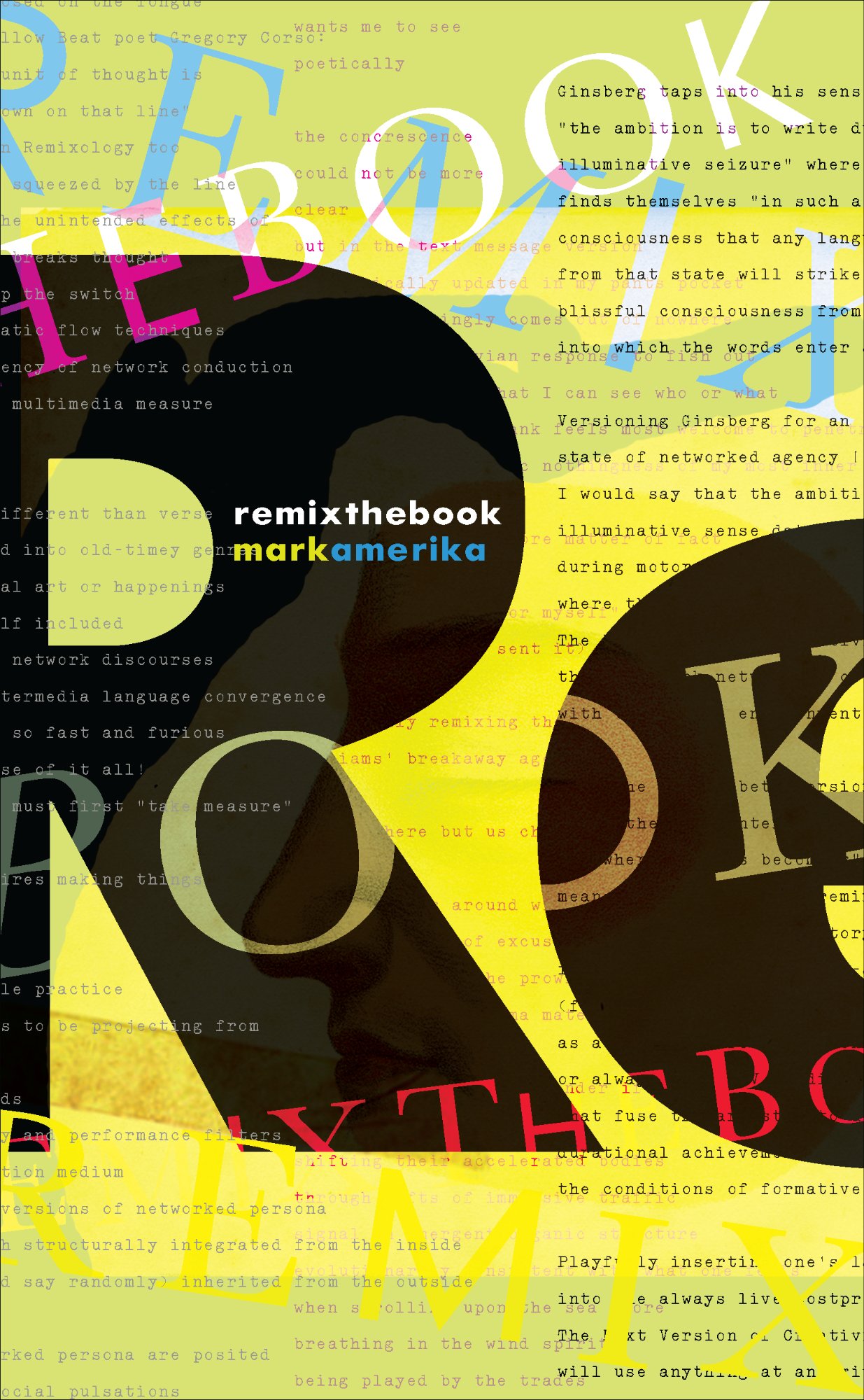
What better way to introduce Mark Amerika's remixthebook than to remix it? Here is a short-play version of Mark Amerika's introduction to the print version of remixthebook published by the University of Minnesota Press:
This is not a book per se. Think of it more as a hybridized publication and performance art project that appears in both print and digital forms. The work started out as a series of theoretical performances that took place in my Professor VJ blog but that have since been remixed into this multi-track composition featuring selectively sampled phrases and ideas from visual artists, poets, novelists, musicians, theorists, comedians, and process philosophers who have influenced my own creative practice throughout my life.
One of the main reasons remixthebook is more than a print book published by a prestigious university press is that the work expands the concept of writing to include multimedia art forms composed for networked and mobile media environments. For example, this site you are presently visiting: remixthebook.com. This Web site is the online hub for the digital remixes of many of the theories generated in the print book. One of the primary aims of the project is to create interdisciplinary, avant-pop approaches to the way contemporary theory is performed and to anticipate future forms of writing that challenge traditional modes of scholarly production. Taking on the philosophical issues of our time by employing rhetorical styles that mash-up the language of conceptual art with new media theory and the digital poetics generally associated with social and mobile media networking, remixthebook could be considered an experiment in creative risk management where the artist, also a professor, is willing to drop most if not all academic pretense and turn his theoretical agenda into (a) speculative play.
How do collaboratively generated forms of artist theory, forms that encourages others to remix the Source Material Everywhere, challenge traditional forms of scholarly discourse? Maybe it has something to with innovating new modes of theoretical performance that intentionally mash-up the jargon of academic writing with the avant-pop forms of digital rhetoric generally found in new media culture. In the remixthebook project, the notion of "performing theory" is a part of a larger practice-based research agenda where the networked and mobile media artist intuitively constructs their various conceptual personae to see exactly what it is they are in the process of becoming. This relates to one of the quotes in remixthebook attributed to the writer E. L. Doctorow who once said, "[y]ou write to find out what you're writing." But when it comes to writing and/or making and/or intuitively performing acts of what, in the book, is referred to as metamediumystic postproduction, the contemporary artist uses digital processes and the gestural manipulation of the magic keyboard at their fingertips when accessing The Network, to remix their creative potential once again. Contrary to the recent spate of reactionary books suggesting that the Internet is producing a "dumber than dumb" generation of anti-thinkers, remixthebook attempts to introduce a proactive model of creative engagement with the Source Material Everywhere.
The opening page of remixthebook samples a quote from the artist Marcel Duchamp. In "The Creative Act," his by now famous speech in Houston in 1957, Duchamp said:
If we give the attributes of a medium to the artist, we must then deny him the state of consciousness on the esthetic plane about what he is doing or why he is doing it. All his decisions in the artistic execution of the work rest with pure intuition and cannot be translated into a self-analysis, spoken or written, or even thought out.In remixthebook, the persona who writes and remixes the source material at will, improvises with Duchamp's source material and postproduces this mantra for the early 21st century:
If we are all artist-mediums, we must then accept the fact that we are all in perpetual postproduction and that our aesthetic fitness relies on our ability to trigger novelty out of our unconscious creative potential. All of the decisions we make while performing our ongoing work of postproduction art rest with pure intuition and are envisioned as part of the creative act.In The Course section located on the remixthebook.com Web site, the first exercise students are invited to experiment with is very simple: remix the two quotes above through your own artist-generated filters and, in the process, succinctly begin developing your own artist statement that declares what it means to be a creative medium in an age of information overload.
How is the self-identified avant-garde, new media artist of today, one who readily reveals their remixological tendencies and is forever caught in the throes of a predetermined capitalist business cycle and whose poetic performances are co-dependent on branding and labeling as much as any other given professional trying to survive in a digitized "society of the spectacle," forced to position themselves in relation to the reigning administration of multinational corporate culture? Given that this is a theme that resonates throughout all of my installations, feature-length films, Net art projects, live A/V performances, and experimental novels, it should come as no surprsie that remixthebook also attempts to "articulate the grammar of Creativity" as a hacktivist countermeasure to the syntactic algorithms produced by the well-scripted prophets of global capital.
It should be noted that it was only after I had already performed these long form remixes captured in the print version of the project, that I once again was able to realize how immersed in my unconscious creative potential I had become. Remixology, i.e. the art of surfing the Source Material Everywhere for useful data that can then be sampled from and manipulated into a pseudo-autobiographical theoretical performance, presents artists with a powerful protocol to create their own digital flux personae in pursuit of what Allen Ginsberg refers to as "prophetic illuminations." These illuminations are not purely intellectual, artistic, emotional, scientific, or academic. If anything, we might refer to them as intense aesthetic facts.
Make no mistake about it: as I remix the source material that fills the pages of the print book into a multitude of other creative projects, I am self-consciously aware of the fact that what lay at the root of my theoretical performances is how they instantiate "the next version of Creativity" coming.
[Please note: this short-play remix of the introduction to remixthebook is in a constant state of flux. If you have any samples or filters you would like to share for possible inclusion in my next version, please send them directly to me via the mail icon at remixthebook.com]